
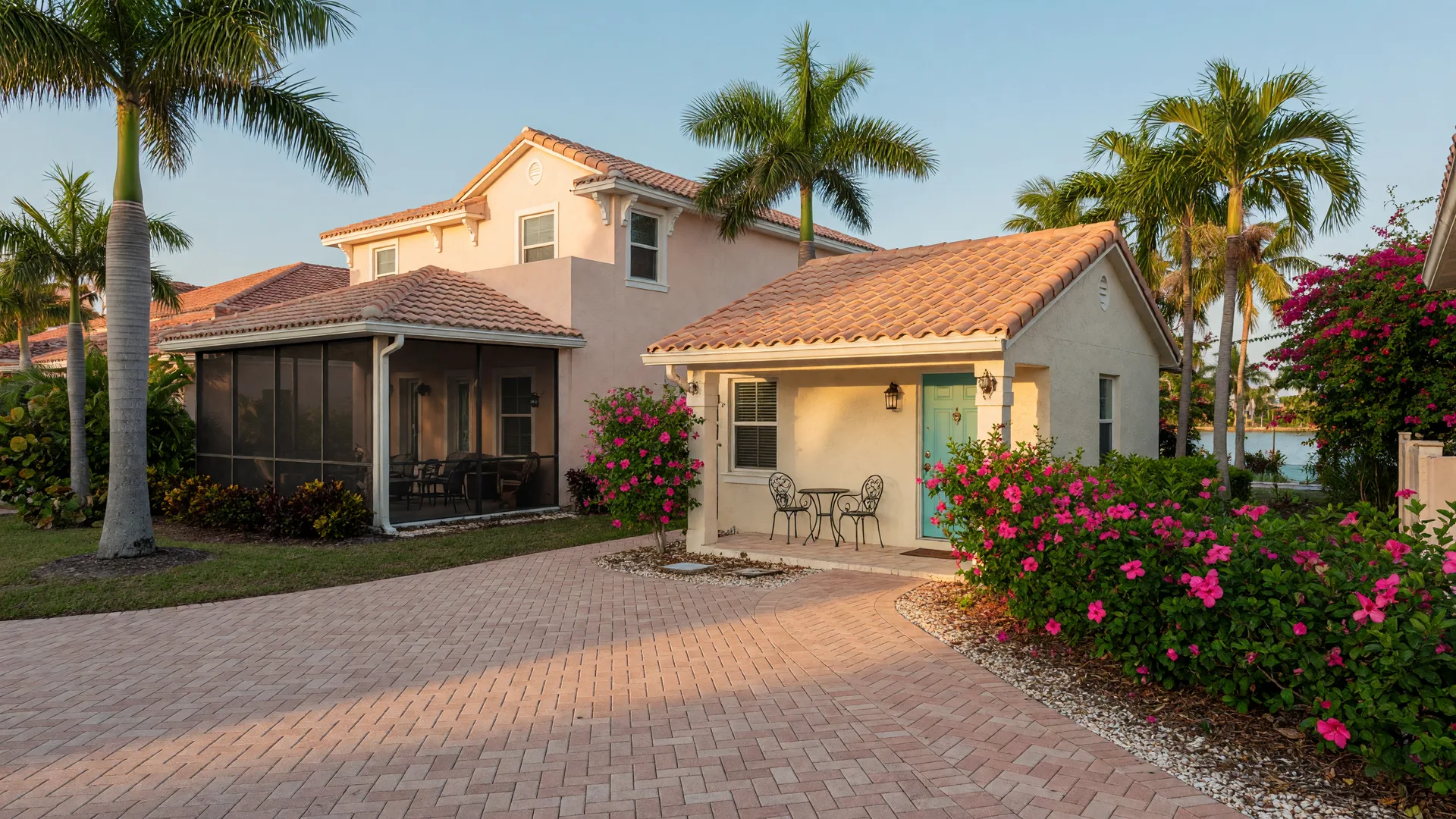
Can You Build a Mother-in-Law Suite in Sarasota, Manatee, or Charlotte County? ADU Rules for 2026
Written by Kim Donahue, REALTOR® with Medway Realty | 30+ Years of Real Estate Experience · Updated September 28, 2026
Yes, in most areas of all three counties you can build an accessory dwelling unit, or ADU, but the rules are local, they are not uniform, and they changed within the last two years. Sarasota and Manatee Counties both allow attached or detached units with their own kitchen and bath in many single-family zones, while Charlotte County reviews ADUs under its land development code. This guide walks through what Florida law allows, where each county stands in 2026, and what to verify before you design anything, because the difference between a permitted suite and an expensive mistake comes down to zoning on your specific lot.
What is an accessory dwelling unit in Florida?
Florida Statute 163.31771 defines an accessory dwelling unit as an ancillary or secondary living unit with its own kitchen, bathroom, and sleeping area, either inside the same structure as the primary home or on the same lot. You will hear them called mother-in-law suites, casitas, granny flats, guest cottages, or rental annexes, depending on the builder and the neighborhood. Two things make an ADU different from a finished bonus room: a separate entrance, and its own kitchen, which is what gives family members genuine independence on the same property.
Does Florida law require every county to allow ADUs?
Not yet. The state statute authorizes local governments to permit ADUs, but as of late 2026 there is no statewide requirement that they do so. A 2025 bill that would have mandated ADU ordinances by December 1, 2025 passed the Florida Senate but died in the House over a dispute about short-term rentals. Its successor, Senate Bill 48, passed the Senate unanimously in February 2026 and would require every county and municipality to adopt an ordinance allowing ADUs by right in single-family districts by December 1, 2026. It still needs House approval and the Governor's signature, so check the current status before you plan around it. The practical point for buyers: the rules you build under today are set by your county and city, not by Tallahassee, and that is where the real differences live.
Does Sarasota County allow ADUs?
Sarasota County has allowed ADUs and guest quarters with full kitchens in many single-family residential areas since its 2019 ordinance, and it does not count them as extra density or require rezoning for a permitted use. That covers most unincorporated areas of the county, from the mainland communities to neighborhoods in the Sarasota and Venice areas, but not every district and not deed-restricted communities, which can have their own covenants on top of county rules. The City of Sarasota went further in 2021, allowing attached or detached ADUs citywide in most single-family residential zones, outside the barrier islands and deed-restricted neighborhoods, with a size limit of about 650 square feet. If you are looking at a specific property, the first step is confirming which jurisdiction it sits in: city, county, or a deed-restricted community with its own restrictions.
Can you build an ADU in Manatee County?
Manatee County allows attached or detached accessory dwelling units in its A, A-1, RSF, PD, and Village zoning districts, and a January 2025 revision removed the old 750 square foot size cap and ended the blanket restriction on the number of subordinate units. The units still need their own kitchen and bath and must be subordinate to the primary home. A few areas, including the Whitfield Residential Overlay and Bayshore Gardens Park, do not allow them. So the honest answer for Bradenton, Lakewood Ranch, Parrish, and Palmetto is: probably yes, but only after verifying the district of the exact lot, because two streets apart can be two different answers.
What about Charlotte County?
Charlotte County does not have the same countywide pattern as Sarasota and Manatee, so the rule depends on the parcel. In Port Charlotte, Punta Gorda, and the island communities, the land development code and the district for the specific lot decide whether an ADU, guest suite, or second unit is a permitted use or requires a special review. Because the details vary more here, the reliable move is to look up the parcel's zoning on the county's site or call the planning department before you pay for plans. It takes twenty minutes and saves a lot of heartache.
Can I rent out my ADU?
Long-term rentals are allowed in many Sarasota County zones under the same ordinances that permit the units, which is why so many buyers consider an ADU a source of income. Short-term vacation rentals are a separate question with their own rules: a state vacation rental license, local registration in many cities, minimum-stay requirements, and tourist taxes, and many deed-restricted communities prohibit them outright. The rules are layered, so read how short-term rentals work in Sarasota, Manatee, and Charlotte Counties before you count on Airbnb income to make the math work.
Is an ADU the right move, or would a home with a suite fit better?
That is the question worth asking before you build, especially for my clients who are moving closer to adult children or grandchildren. A detached ADU gives the most independence, but it means permitting, construction, and added insurance on top of the purchase. An existing floor plan with an attached in-law suite, a dual-primary-suite layout, or a connected casita often delivers 90 percent of the benefit with none of the construction. If the goal is staying close to family rather than running a rental, start by looking at homes that already have the suite, then compare the premium against what a build would actually cost. I walk through that comparison with clients every week, and the answer is personal. Read more about how multigenerational living works in these three counties and how to help parents downsize and move to Florida when the move is happening across generations.
What should you do before you build?
First, verify the zoning and permitted uses for the exact lot with the county or city, and read the deed restrictions if the neighborhood has an HOA. Second, talk to a local builder or architect about setbacks, parking, utilities, and impact fees, and get three written bids rather than planning from a number a friend heard somewhere. Third, ask your insurance agent what an ADU does to your homeowners policy, and your tax advisor whether the unit is assessed separately, because both change your monthly reality. If Senate Bill 48 becomes law, future permits will also require proof that the homeowner occupies the primary dwelling, another reason to sort out the plan before construction starts. And if you are still looking for the property itself, bring this list with you, because the lot, the jurisdiction, and the covenants are the parts you cannot change later.
I'm Kim Donahue, a REALTOR® with Medway Realty, licensed in Florida as SL3352997, serving Sarasota, Manatee, and Charlotte Counties. I have spent more than 30 years matching people with homes that fit how they actually live, including multi-generational households and downsizers who want family close but space of their own. Call me at (941) 724-2587 or reach me through my contact page, and we can look at the rules for the specific homes you are considering. I've got your back.