
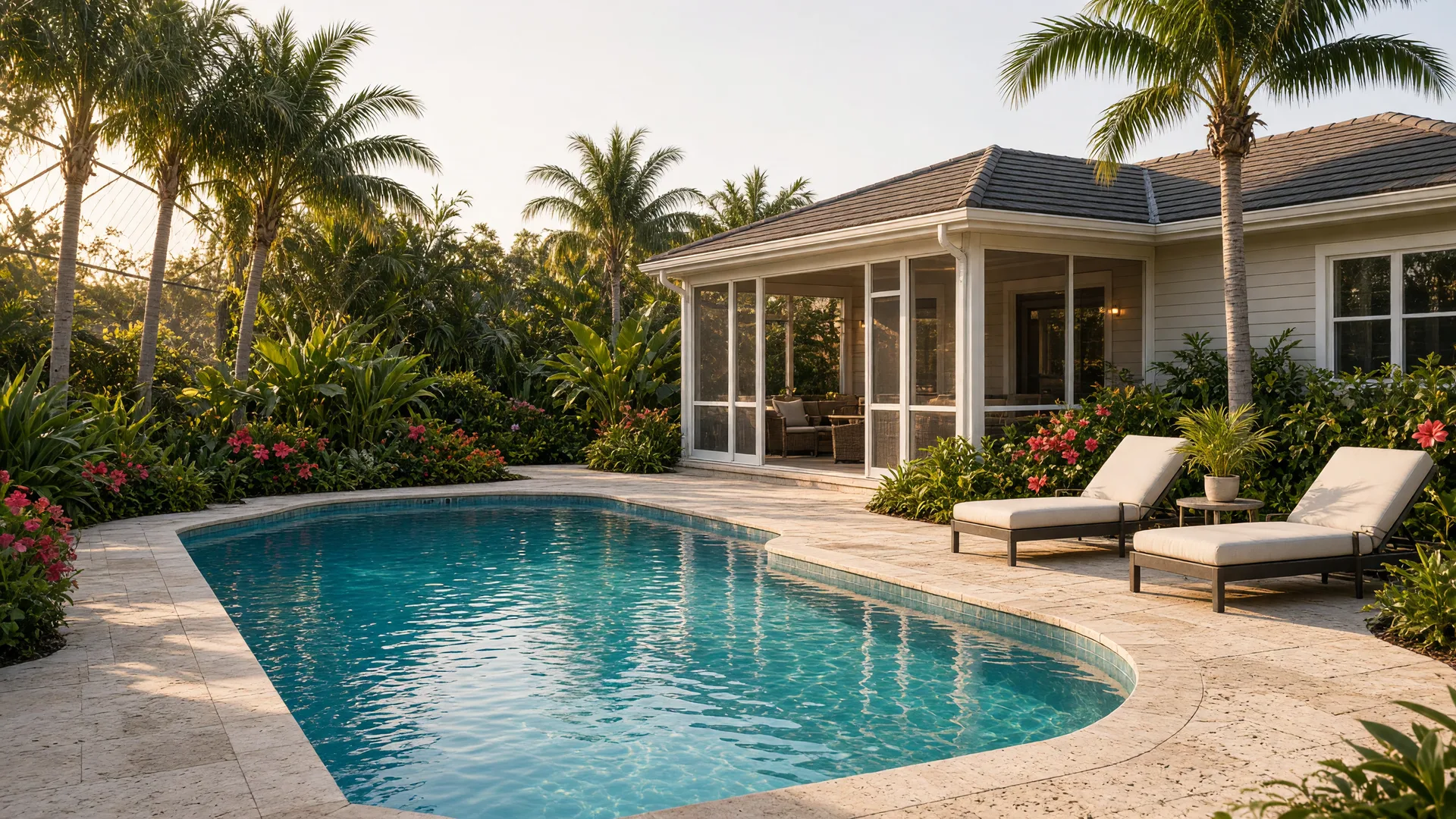
Should You Buy a Home With a Pool in Florida? The Real 2026 Cost Breakdown
Written by Kim Donahue, REALTOR® with Medway Realty | 30+ Years of Real Estate Experience · Updated November 4, 2026
In Sarasota, Manatee, and Charlotte Counties, a swimming pool can be the reward at the end of a downsizing move, a summer anchor for grandkids, or a monthly line item you wish you had priced before the offer. The honest answer to whether you should buy a home with a pool is: it depends on how you will use it, what it costs to maintain, and what it does to your insurance, and each has real numbers attached. Here are the numbers I put in front of clients sitting across the table, so the decision is a calculation.
How much does a pool cost to build in Florida?
If the home does not already have a pool, a new in-ground pool costs roughly $35,000 to $120,000 in this market, with most mid-range concrete and fiberglass projects landing between $55,000 and $95,000 before upgrades. Additions like a spa, a screen enclosure, or heating push the total higher. An above-ground pool is dramatically cheaper, but it adds little to resale value, so it rarely makes sense on a home you plan to sell. The exact figure depends on soil, access, and finishes.
How much does a pool cost to keep up every year?
Ongoing costs break into three recurring lines: chemicals, electricity, and either your time or a service professional. Chemicals run about $20 to $60 a month on a do-it-yourself plan, and electricity for the pump typically runs $40 to $80 a month with an efficient pump. If you hire a weekly pool service, that is another $100 to $175 a month. All told, expect $75 to $125 a month if you do the work yourself, or $150 to $275 a month with professional care, plus the occasional equipment repair.
Does a pool add value to a Florida home?
In coastal markets where pools are common, a well-maintained in-ground pool typically adds roughly 7 to 15 percent to resale value, and most coastal buyers treat a pool as expected rather than a bonus. The catch is that the premium usually does not cover the full cost of building new. If you are buying an existing home, the pool is already priced into the listing. If you are adding the pool yourself, treat it as a lifestyle purchase with partial resale return, not an investment.
How does a pool affect homeowners insurance?
Adding a pool typically raises an annual premium by about $50 to $300, and more with a diving board or slide, which some carriers treat as added liability risk. In higher-risk coastal ZIP codes, a carrier may decline coverage or charge a larger surcharge, and Florida law requires a four-foot or taller safety barrier around residential pools. Insurers generally want higher liability limits, and the pool structure itself is covered under other structures. Call your insurance agent before you commit, and read quotes line by line. My 2026 homeowners insurance guide covers the broader Sarasota, Manatee, and Charlotte County picture.
Should downsizers buy a pool or rely on a community pool?
I hear this question most from empty nesters considering 55-plus communities. A private pool means you control the temperature, the crowd, and the hours, and you can swim without walking to the clubhouse. It also means you own the upkeep: the pump, the filter, the chemicals, and the eventual liner or surface repair. For many downsizers, a screened lanai pool becomes a second living room in season. For others, the community pool plus a spa is plenty. There is no right answer, only an honest count of how many days a year you will swim. My guide to touring a 55-plus community includes the amenity questions worth asking.
How do you know if a pool is worth it for you?
Run the numbers against your own habits: how many months a year will you use it, will you maintain it yourself or pay for service, what does it do to your insurance quote, and does the community already offer a pool you will rarely use. If yes, favor an existing, well-documented pool you can inspect, with equipment age and surface condition disclosed up front. If the answer points to no, you are not losing anything; the Gulf is a perfectly good swimming hole.
Pool decisions belong on the checklist next to flood insurance, HOA fees, and property taxes, not after. I help buyers across Sarasota, Manatee, and Charlotte Counties compare homes with and without pools, price the real monthly cost of each, and negotiate with the full picture. My guide to the true monthly cost of a Florida home is a good place to start, and my article on moving from a house to a condo covers the amenity trade-offs downsizers weigh.
Reach me at (941) 724-2587 or through the contact page. I am Kim Donahue, a REALTOR with Medway Realty, licensed in Florida as SL3352997, and I have been guiding buyers and sellers through decisions like this for more than 30 years.
The short version: a pool is a lifestyle purchase with real, predictable costs. Price the monthly number before you make the offer, and you will never be surprised by the water bill or the insurance rider.