
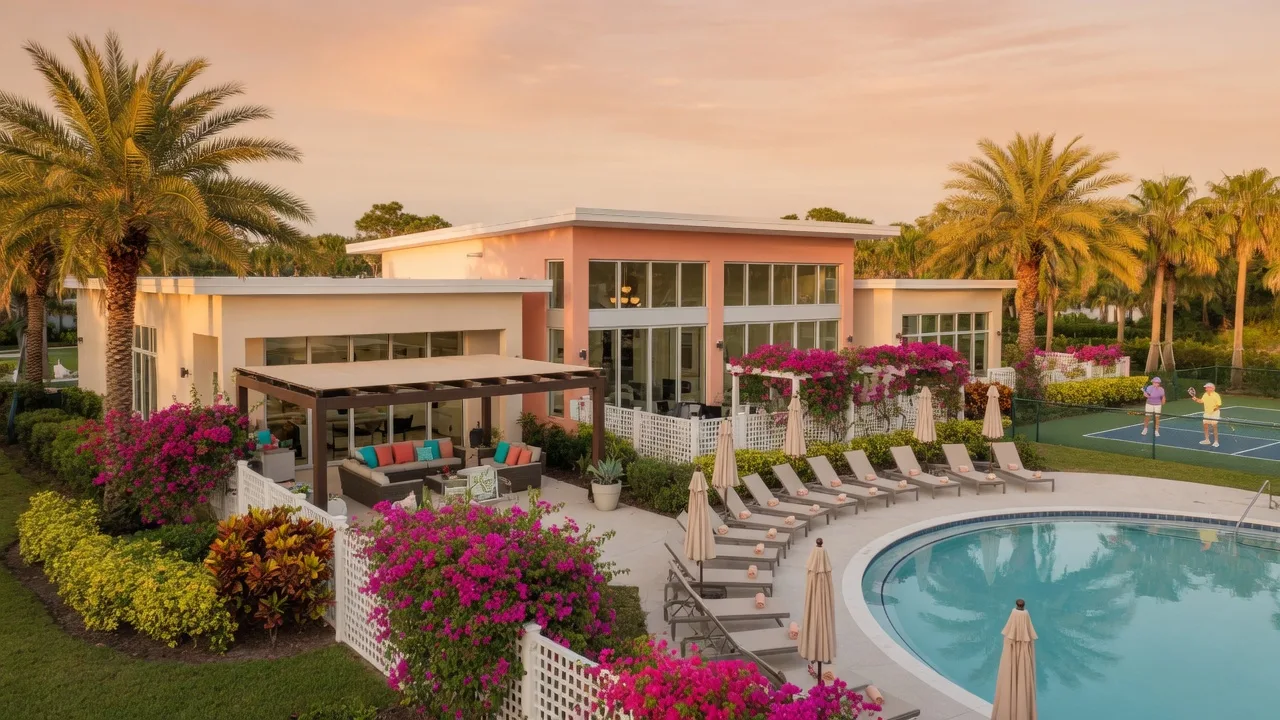
What Downsizers Should Look for When Touring a 55+ Community in Sarasota or Manatee County
Written by Kim Donahue, REALTOR® with Medway Realty | 30+ Years of Real Estate Experience · Updated August 10, 2026
If you are considering a 55-plus community in Sarasota, Manatee, or Charlotte County, you have probably already visited a model home or two. The model is designed to impress — the finishes, the layout, the light pouring through the windows. And it should impress you. But a model home tells you very little about whether the community is the right fit.
The decision to move into an active adult community is not just a housing decision. It is a lifestyle decision. Here is what I recommend every downsizer look for beyond the granite countertops and tray ceilings.
Start with the Financial Health of the Association
This is the single most important thing to investigate, and it is also the one most buyers skip because it feels uncomfortable to ask about. Do not skip it.
Ask for the association's most recent financial statements and reserve study. You want to see whether the HOA is adequately funding its reserves for major expenses like roof replacements, paving, and pool repairs. A community that has kept dues artificially low by deferring maintenance is a community that will hit you with a special assessment later.
This is especially relevant in 2026. Florida's new condominium reserve requirements have raised awareness about structural funding, but the same principle applies to single-family and villa HOAs. A well-run association budgets for the long term. A poorly run one kicks the can down the road, and the new owners end up paying for it.
Understand the Full Monthly Cost, Not Just the HOA Fee
The HOA fee is only one piece of the monthly picture. In many master-planned communities, particularly newer ones in Manatee and Charlotte Counties, you will also have a CDD (Community Development District) assessment that appears on your property tax bill. In Lakewood Ranch villages, annual CDD fees range from roughly $1,500 to $4,500 depending on the neighborhood. In Wellen Park and Del Webb communities, expect $1,500 to $3,500 per year.
When you add HOA fees, CDD assessments, homeowners insurance, flood insurance (if required), and property taxes together, the true monthly cost of a home can be significantly higher than the principal and interest alone. I wrote a detailed breakdown of the true monthly cost of buying a home in Florida that walks through each of these line by line. For a specific look at HOA and CDD costs across the region, my guide to HOA fees and CDD assessments covers what to expect in each county.
Visit on a Weekday, Not Just a Saturday
Model homes and sales centers are busiest on Saturdays, and that is when the community puts on its best face. To get a real feel for daily life, come back on a Tuesday or Wednesday morning. Walk the common areas. Sit by the pool. See how many people are actually using the amenities, and what the atmosphere feels like when there is no sales event happening.
Is the clubhouse active and social, or quiet and empty? Are residents gathering in common spaces, or does everyone keep to themselves? There is no right answer — some people want a busy social calendar, others want peace and quiet — but you need to know which one you are signing up for.
Talk to Residents, Not Just the Sales Team
The sales team knows the community's selling points. The people who actually live there know the reality. If you see a resident walking a dog or gardening, introduce yourself. Ask what they wish they had known before moving in. Ask about noise, about management responsiveness, about whether the community lives up to the brochure.
Most residents in active adult communities are happy to share their experience, and their answers will tell you more than any tour.
Look at the Resale Homes, Not Just New Construction
If the community has been built out for a few years, the resale homes will tell you a different story than the model homes. Walk the resale section. Check how well the original construction has held up. Look at landscaping — is it maintained uniformly, or has it become uneven as individual owners take different approaches? Check whether roofs, driveways, and common-area paint look fresh or tired.
A community where the resale homes are well maintained and the common areas look consistently cared for is a community with an active, engaged HOA. That is a good sign. A community where the new construction section looks polished but the older sections look neglected may indicate that the association is underfunded or that the developer's standards did not carry through to the long-term management.
Consider Proximity to What You Actually Do
The clubhouse is nice, but how close is the grocery store? The nearest hospital or urgent care? Your preferred golf course, church, or social group? A beautiful community that sits 25 minutes from the nearest supermarket can feel isolating, especially for someone relocating from out of state without an existing local network.
For downsizers moving to Sarasota, Manatee, or Charlotte County from elsewhere, proximity to healthcare is often the most practical concern. I cover this in detail in my guide to healthcare access for retirees in the tri-county area, which maps out the hospitals, urgent care centers, and medical facilities by region.
Ask About the Amenities You Will Actually Use
Every 55-plus community markets its amenities. The key question is which ones matter to you. A resort pool is nice, but if you do not swim, it does not add value to your life. A full calendar of social events is a draw for some residents and a turnoff for others who prefer quiet.
Before you tour, make a short list of the three amenities you would use most often. Pickleball courts? A fitness center with classes? A woodworking shop? A community garden? A library? Then check specifically for those. If a community's main selling point is its golf course and you do not play golf, you are paying for something you will not use.
The Bottom Line
A 55-plus community in Southwest Florida can be an excellent fit for the right buyer. The key is to evaluate it the same way you would any major decision: with your eyes open, asking the real questions, and looking past the sales presentation. The model home is a preview of the product. Everything else — the finances, the neighbors, the daily experience — is the real purchase.
If you are comparing active adult communities across Sarasota, Manatee, or Charlotte County and would like someone to walk through the trade-offs with you, I would be glad to help. I serve buyers across all three counties, and I know these communities from the inside.
For a full list of active adult options in the area, start with my guide to 55-plus communities near Sarasota. If you have specific questions about a community or want to talk through your situation, call me at (941) 724-2587 or visit my contact page.