
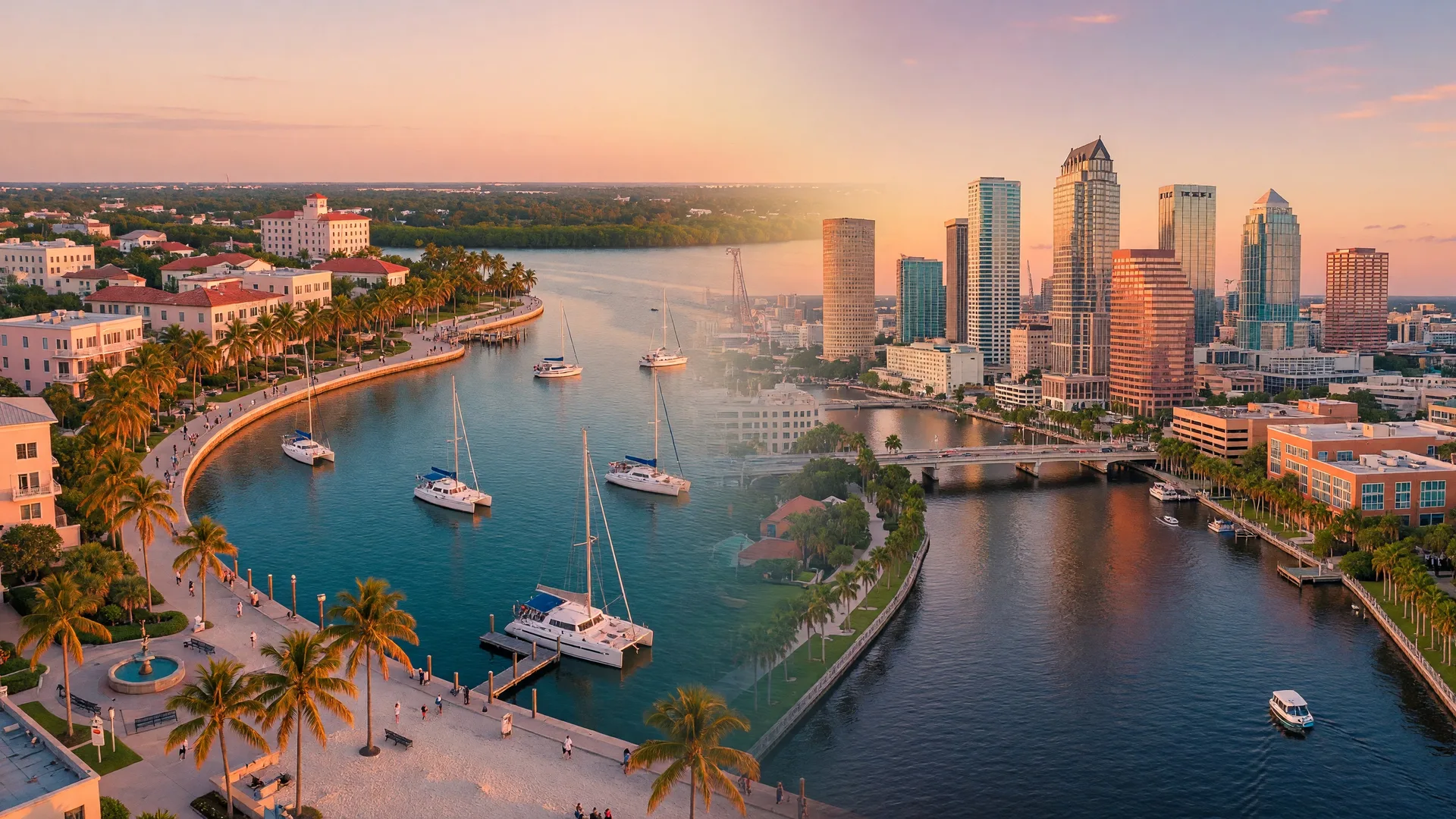
Sarasota vs. Tampa: Which Florida City Is Right for You?
Written by Kim Donahue, REALTOR® with Medway Realty | 30+ Years of Real Estate Experience · Updated July 12, 2026
If you're weighing a move to Florida's Gulf Coast, two cities keep coming up: Sarasota and Tampa. They sit about an hour apart on I-75, share the same stretch of coastline, and both offer warm weather, no state income tax, and access to the Gulf of Mexico. But the day-to-day experience of living in each one is genuinely different — and the right choice depends on what matters most to you.
I work across both markets. I help clients buy and sell homes in Sarasota, Manatee, and Charlotte Counties every day, and I also advise people who are comparing these two metros before they commit. Here's an honest, side-by-side breakdown of how they actually compare — not marketing copy, but the facts I walk through with clients who are trying to decide. If you want to understand the broader financial picture, my cost of living in Sarasota guide goes deeper on local expenses. And if you're relocating from up north, my guide for Midwest relocators and Northeast relocators cover the emotional and practical side of the move.
Cost of Living: Housing, Insurance, and Taxes
Both cities are more expensive than the national average, but Sarasota leans higher — primarily because of housing.
Housing: Sarasota's median home price hovers around $500,000–$550,000 depending on the source and time of year, while Tampa's median sits closer to $380,000–$430,000. The gap is meaningful — roughly $100,000 or more at the median. In Sarasota, that premium buys proximity to the Gulf beaches, barrier island access, and a more resort-like setting. Tampa offers more housing inventory at lower price points, especially in neighborhoods north and east of downtown.
Rent: Median rent in the Sarasota area runs about $2,400–$2,500 a month for a one- to two-bedroom unit. Tampa rents are slightly lower on average, particularly outside the downtown and South Tampa corridors.
Insurance: This is the line item that surprises most people, regardless of which city they choose. Florida homeowners insurance averages $4,000–$6,000+ a year statewide, and both metros are in elevated-risk zones. Sarasota County and Hillsborough County rates are comparable for standard homeowners policies, though flood insurance costs vary significantly by zone. If you're buying near the water or on a barrier island, expect flood premiums to add meaningfully to your annual cost — and read my Florida homeowners insurance guide for the details.
Taxes: Neither city has a state income tax — that's a Florida benefit. Sales tax is 7% statewide, with local surtaxes adding 1% in both areas. Property tax rates are similar across the two counties, though assessed values are higher in Sarasota, which means a larger tax bill on a comparably priced home. Florida's homestead exemption and Save Our Homes cap apply in both cities and protect long-term homeowners from runaway assessments.
Job Market and Economy
Tampa has the larger, more diversified economy — and it isn't close. The Tampa–St. Petersburg–Clearwater metro area is the second-largest in Florida, with over 3.4 million residents and a labor force exceeding 1.7 million. Major industries include healthcare, financial services, information technology, education, and advanced manufacturing. The region has attracted significant corporate investment in recent years, with companies in fintech, cybersecurity, and life sciences establishing or expanding operations in the Tampa Bay area.
Sarasota's economy is smaller but growing quickly. The North Port–Bradenton–Sarasota metro has roughly 935,000 residents and is one of the fastest-growing MSAs in the state. The dominant sectors are healthcare, retail, hospitality, and construction — driven in part by the population growth itself. Median household income in Sarasota County sits around $85,000, which is notably higher than the state average of roughly $69,000.
For someone who needs to commute to a corporate office, Tampa offers significantly more job opportunities within a short drive. For remote workers, retirees, business owners, or people in service-oriented industries, Sarasota's smaller economy isn't a drawback — and the quality of life trade-off is often the reason people choose it.
Culture, Dining, and Entertainment
Tampa has more to offer in sheer volume. The city has professional sports teams — the Buccaneers, Lightning, and Rays — a major performing arts complex, a growing food scene across neighborhoods like Hyde Park, Seminole Heights, and the Riverwalk district, and a nightlife infrastructure that Sarasota doesn't try to match. Busch Gardens, the Florida Aquarium, and the Straz Center for the Performing Arts are anchors, and the city's cultural calendar is packed year-round.
Sarasota's cultural identity is different. It leans more toward the arts, performing arts, and visual culture than toward sports and nightlife. The Ringling Museum of Art, the Sarasota Opera, the Asolo Repertory Theatre, and the Sarasota Art Museum give the city a cultural depth that's unusual for a city its size. St. Armands Circle, Main Street in downtown Sarasota, and the Palm Avenue galleries create walkable pockets of dining, shopping, and galleries that feel curated rather than sprawling. For a sense of what daily life looks like, my things to do in Sarasota guide covers the highlights.
The short version: Tampa has more options. Sarasota has more character. Neither is wrong — it depends on whether you want a city that keeps you busy or one that lets you settle into a rhythm.
Beaches and Outdoor Recreation
This is where Sarasota pulls ahead for most people, and it's not particularly close.
Sarasota has direct access to some of the best beaches in the United States. Siesta Key Beach — with its quartz-crystal sand that stays cool underfoot — regularly ranks among the top beaches in the country. Lido Key, Longboat Key, and the beaches of Anna Maria Island are all within a 20- to 40-minute drive of downtown Sarasota. The water is calmer, the beaches are less crowded, and the barrier islands have a slower, more relaxed character.
Tampa has beaches too — Clearwater Beach and St. Pete Beach are both excellent and attract large crowds, especially in season. But they're on the other side of Tampa Bay, which means a 45- to 75-minute drive from most Tampa neighborhoods depending on traffic. For Tampa residents, a beach day is an outing. For Sarasota residents, it's a Tuesday afternoon.
Both cities offer good options for golf, kayaking, fishing, and nature preserves. Tampa has the Hillsborough River State Park, the Lettuce Lakes Park, and access to the Everglades headwaters. Sarasota has Myakka River State Park, the Celery Fields, and world-class fishing in the Gulf. If beach access is a daily priority rather than a weekend plan, Sarasota wins this category clearly. My guide to the best beaches in Sarasota breaks down each one.
Healthcare and Hospitals
Tampa has the more complex healthcare landscape, with multiple competing systems and nationally ranked institutions. Tampa General Hospital is a Level I trauma center and a major academic medical center affiliated with USF Health. Moffitt Cancer Center is an NCI-designated Comprehensive Cancer Center — one of the top cancer hospitals in the country. BayCare Health System operates 16 hospitals across the Tampa Bay region, and AdventHealth and HCA Florida add additional facilities. For complex specialty care, rare conditions, or if you want proximity to a major academic medical center, Tampa has the edge.
Sarasota's healthcare is anchored by Sarasota Memorial Health Care System, one of the largest public, non-profit hospital systems in Florida. Sarasota Memorial Hospital is an 895-bed regional referral center that consistently earns high marks — including 5-star CMS ratings and Leapfrog "A" grades. The system also includes SMH-Venice and continues to expand. Doctors Hospital of Sarasota, Lakewood Ranch Medical Center, and HCA Florida Blake Hospital in Manatee County add additional options. Johns Hopkins All Children's has outpatient presence in Sarasota as well.
For most day-to-day healthcare needs, Sarasota is well served. For highly specialized or tertiary care — oncology, complex cardiac surgery, transplant services — Tampa's concentration of major systems provides more depth. If you're relocating for retirement and anticipate needing ongoing specialist care, it's worth knowing that Tampa is about an hour north, and many Sarasota residents do make that drive when needed.
Climate and Hurricane Risk
Both cities share a humid subtropical climate with hot, humid summers and mild winters. Average highs in summer hover around 90°F in both locations, and winter lows rarely drop below the mid-50s. Tampa runs slightly warmer on average — about 77°F annually versus 76°F in Sarasota — but the difference is negligible in practice.
The bigger question is hurricane exposure, and this is where the history gets interesting. Tampa Bay's geography — the wide, shallow bay that funnels storm surge directly into the coast — gives it one of the highest theoretical storm-surge risks in the United States. A direct Category 3 or higher hit on Tampa Bay could be catastrophic for the coastal areas. Historically, though, Tampa has dodged direct major hurricane hits for over a century — the last direct major hit was the 1921 Tarpon Springs Hurricane. That long "lucky streak" has led some researchers to study whether geographic or atmospheric patterns provide a natural shield, though most meteorologists caution that the streak is more luck than science.
Sarasota has experienced more direct hurricane impacts over the same period, including Hurricane Charley in 2004 and — most recently — Hurricane Milton in 2024, which made a direct hit on Sarasota County. Sarasota County averages a direct hurricane impact roughly every 20 years within 40 miles. The barrier islands (Siesta Key, Lido Key, Longboat Key) are particularly exposed to storm surge.
Both cities face the same reality: Florida's Gulf Coast is hurricane country, and neither city is immune. The insurance costs reflect that. The practical difference is that Tampa's risk may be more concentrated in a catastrophic surge event, while Sarasota's risk is more frequent but historically less extreme. Neither is a reason not to buy — but it is a reason to understand your flood zone, carry proper insurance, and take building standards seriously.
Traffic and Commute
If you've spent any time on I-75 during season, you already know that traffic in Southwest Florida is a real consideration — and it affects both cities.
Tampa's traffic is heavier in absolute terms. The metro area has over three times the population of the Sarasota metro, and the I-275 corridor, the Selmon Expressway, and the I-75/I-4 interchange are all consistently congested during peak hours. Average commute times in Tampa run about 28–30 minutes, which is close to the national average, but rush-hour delays can push that significantly higher.
Sarasota's traffic is lighter but growing. I-75 through Sarasota and Manatee Counties backs up during morning and evening commutes, particularly near the University Parkway and Bee Ridge Road exits. Average commutes are shorter — typically 20 to 25 minutes — but seasonal snowbird traffic adds congestion from November through April. For people working within Sarasota County, commutes tend to be manageable. For anyone commuting between Sarasota and Tampa (or vice versa), plan on 50 to 70 minutes each way during peak times.
Neither city has meaningful public transit. Tampa's HART bus system and the TECO Line streetcar serve limited areas, and Sarasota's SCAT bus system covers the county but doesn't serve most commuters' needs. Both cities are designed around car ownership. If you're evaluating walkability, Sarasota's downtown and some barrier island neighborhoods offer it; Tampa's walkable areas are more neighborhood-specific (Hyde Park, downtown, Channelside).
Retirement Lifestyle
Both cities are popular retirement destinations, but they attract different types of retirees.
Sarasota has a well-established retiree community and the infrastructure that comes with it. The area has dozens of 55-plus active adult communities — from Del Webb Lakewood Ranch to Sarasota National and Grand Palm — with resort-style amenities, social calendars, and maintenance-free living. The pace is slower, the cultural institutions are strong, and the beach access is unmatched. For someone who wants to settle into a retirement that balances activity with calm, Sarasota is purpose-built for it. I cover this in more depth in my retiree's guide to Sarasota and my honest take on what retiring to Sarasota is really like.
Tampa offers a more urban retirement experience. For retirees who want to stay connected to professional networks, cultural events, sporting events, and a more active social scene, Tampa provides that in a way Sarasota doesn't attempt. It also has the healthcare depth that matters for retirees with complex medical needs. The trade-off is a more hectic pace, higher traffic, and less direct beach access.
For retirees specifically considering downsizing or right-sizing, Sarasota's market has more inventory in the $300,000–$600,000 range that suits single-level living, and the community of advisors, organizers, and moving specialists built around that transition is more developed here.
Schools and Education
Families with school-age children will find strong options in both metro areas, but the specifics matter.
Tampa's Hillsborough County Public Schools is the eighth-largest school district in the nation, with a wide range of magnet programs, charter schools, and specialty academies. The district includes well-regarded schools like Plant High School, Steinbrenner High School, and numerous magnet programs for STEM, arts, and IB. Private school options include Tampa Prep, Jesuit High School, and Academy of the Holy Names. The University of South Florida, the University of Tampa, and Hillsborough Community College add higher education options locally.
Sarasota County Public Schools consistently ranks among the top districts in Florida. Pine View School (a publicly funded school for gifted students) is one of the highest-rated schools in the state. Riverview High School, Venice High School, and Sarasota High School all have strong reputations. The district's overall performance metrics — graduation rates, test scores, college readiness — outperform most Florida districts. Private options include Out-of-Door Academy, Cardinal Mooney High School, and Sarasota Christian School. New College of Florida and Ringling College of Art and Design are based in Sarasota.
The quality of life difference for families often comes down to this: Sarasota County schools are generally higher-performing across the board, with less variance between schools. Tampa offers more variety and specialization through its magnet and charter systems, but quality varies more by zone. Both areas have good options — it depends on whether you want consistent county-wide quality or the ability to choose from a wider menu of specialized programs.
Overall Vibe and Feel
This is the part that's hardest to quantify but often matters most.
Sarasota feels like a smaller, more intentional place. The downtown is walkable and culturally rich. The beaches are world-class and close. The pace is slower. People move here to decompress, to enjoy a lifestyle that's shaped around the water, the arts, and a certain ease. It attracts people who want refinement without pretension — the restaurants are excellent, the cultural calendar is packed, but there's no rush to any of it. The population skews older, but younger families are increasingly drawn to neighborhoods like Lakewood Ranch, Palmer Ranch, and Wellen Park.
Tampa feels like a real city — because it is. It has the energy, the diversity, the professional infrastructure, and the cultural depth that comes with a metro area of 3.4 million people. There's a food scene that has gained national attention, neighborhoods with distinct identities, and a sense that the city is still growing into itself. It's younger, faster, and more economically dynamic. The trade-off is the traffic, the sprawl, and the fact that the things people love about Gulf Coast Florida — the beaches, the quiet, the resort-like pace — require a deliberate effort to access.
If you want a city that gives you options, Tampa delivers. If you want a lifestyle that feels like the reward for years of hard work, Sarasota is built for that.
The Verdict: Who Should Choose Which City?
For Retirees and Downsizers
Sarasota is the stronger fit. The 55-plus communities, the slower pace, the beach access, and the established support network for people in transition make it a natural choice. The healthcare is solid for most needs, and Tampa's specialist hospitals are an hour away if you need them.
For Families with School-Age Children
It depends on your priorities. If school performance and a quieter lifestyle matter most, Sarasota County offers top-tier public schools with less variability. If you want more program variety, a wider selection of specialized schools, and a more urban environment, Tampa gives you more choices — though you'll need to research specific zones carefully.
For Remote Workers
Either city works well, since you don't need to commute. The deciding factor is usually lifestyle preference. If you want walkability, beach access, and a more relaxed daily rhythm, Sarasota delivers that in a way Tampa doesn't replicate easily. If you want urban amenities, a larger social network, and lower housing costs, Tampa is the practical choice.
For Investors
Tampa's larger population base, diversified economy, and lower median entry price make it appealing for rental investment and long-term appreciation. Sarasota's higher price points and strong demand in the luxury and second-home segments can yield strong returns in the right neighborhoods — particularly waterfront and barrier island properties. The right investment depends on your strategy, timeline, and risk tolerance.
For Anyone Who Prioritizes Beach Access
Sarasota, without question. Living 15 to 20 minutes from Siesta Key, Lido Key, or Anna Maria Island is a fundamentally different lifestyle than driving an hour to Clearwater Beach from Tampa. If the beach is part of your daily life — not just your vacation plans — Sarasota is where you want to be.
The cities are close enough that you can enjoy the best of both — many of my clients live in Sarasota and drive to Tampa for events, dining, or specialized healthcare. But when you're choosing where to plant roots, the differences are real and they compound over time.
I help people make this decision every day. If you're comparing Sarasota and Tampa — or narrowing down specific neighborhoods within either city — I'll give you an honest assessment based on your priorities, not a sales pitch. If you're considering other nearby communities, my guides to living in Bradenton, living in Venice, and living in North Port cover those options too. And if you're still working through the financial side, my true monthly cost of buying a home in Florida breaks down what your mortgage payment doesn't tell you.
Ready to figure out which city fits your life? Let's talk — I'll help you think through it honestly.